Pages

Showing posts with label Local Ecumenical Partnerships. Show all posts

Tuesday, 13 September 2011

The Sponsoring Body

Mechanics repairing an engine, San Rosalia, Ba...Image by Wonderlane via FlickrThis post is the fourth in a sequence examining some of the issues raised in a new report, 'A Review of Intermediate Ecumenical Life in England' to be published by Churches Together in England in a few weeks time.

Today, I will reflect upon the role of LEPs.  The following are the conclusions at the end of Chapter 9:

Though in some instances lights set on a hill, LEPs have not been the beacons for a united Church in this generation.  Single Congregation LEPs (the most complex) number some 600 in England, out of a rough estimated total of 40 000 congregations.  Their significance within a denomination is marked: they represent a much higher proportion of United Reformed Church congregations than they do of Church of England congregations; d Single Congregation LEPs have not included the Orthodox Churches or the Roman Catholic church, or BME Churches.

Without detracting fro  their positive contribution to the life of the Church of England, the attention they receive from CTE and from IBs is disproportionate, especially against the backdrop of emerging forms of ecumenical life.  The time consumed by LEPs could be spent more creatively, and IBs might be more enthusiastically embraced by Church Leaders if this were so.  However, LEPs are not the only form of local church life that has difficulties, and they should not be criticised unduly.

I believe the problem with LEPs has nothing to do with the time they take or their complexity; it is left over from the times when LEPs were seen as indicators of the ecumenical goal of full visible unity.  At one time they were the only game in town and so the more LEPs, the closer we were to unity.

This view was abandoned  at the end of 1980s and after twenty years its time we caught up with that important change.  LEPs do have a role, a vital role; a role not helped by freighting them with ideological baggage.

LEPs are a tool for mission.  In certain circumstances, they are an appropriate way to organise local churches for mission.  The challenge is to identify the circumstances where they are appropriate and then to set them up with a minimum of fuss.

What has struck me over 8 years working with LEPs, is the number of people who want to spend a great deal of time writing or tinkering with LEP constitutions.  We've done a lot nationally to reduce their complexity and the time it takes to set LEPs up but there is still legacy of people who insist on doing things their way.

If there is a call to mission, amongst two or more local churches, LEPs may be an appropriate response.  This works if the focus is on mission.  As soon as churches get hung up on the minutiae of constitutions, we get into trouble.  We've had decades of experience; the model constitutions are based upon this experience.  They allow churches, through locally agreed guidelines, to organise their affairs with a high degree of flexibility so long as those involved are willing to allow them to do so.

But they are also one tool amongst many others.  There's no pressure to have a LEP, and if circumstances change and it isn't needed any more, then there is no shame in terminating this particular arrangement.  What is important is relationships.  Relationships have priority over structures every time. 

Ask, what do we want to do and what is the best way of doing it.  Talk to ecumenical officers and find the best approach and when circumstances change, be flexible enough to make the necessary changes.
Enhanced by Zemanta

Friday, 9 September 2011

Intermediate Bodies, Past and Present

Ecumenical Church of Christ the CornerstoneImage via Wikipedia
Christ the Cornerstone, Milton Keynes
Before I go on to discuss the four conclusions I highlighted yesterday from Churches Together in England's new report, 'A Review of Intermediate Ecumenical Life in England', I've found the chapter that reviews the history of intermediate ecumenism interesting.

The report lists the various origins of intermediate bodies.  I can't copy all the details here but even in summary it may help us remember the diversity of ecumenical life in England and the legacy of past innovations.
  • City and County Councils of Churches.  There appear to have been only 8 of these of which the 6 latest started in the 1960s.  The earliest was in Manchester in 1917.
  • Church Leaders Meetings.  It isn't clear whether the motivation of these was informal meetings for mutual support or pragmatic response to the needs of secular bodies.  Most likely it was both.
  • County / Diocesan Sponsoring Bodies were always associated with the development of what are today called Local Ecumenical Partnerships.  This explains why intermediate bodies are sometimes referred to as sponsoring bodies as many of them took on this role.  But of course the role does not have to be played by the sponsoring body itself, it can be delegated to another organisation.
  • New Town Developments, ie Telford, Swindon and Milton Keynes.  This explains why although the majority of intermediate bodies are county bodies we have these three exceptions.
  • More recently intermediate bodies can be realigned, ie merge or divide.
At present there are 55 intermediate bodies in England.  These originated from the above sources as follows:
  • 16 Councils of Churches (some Councils of Churches persisted for many years after the formation of Churches Together in .  In Sheffield for example, Sheffield Council of Churches continued for many years after the formation of Churches Together in South Yorkshire.  It doesn't appear as far as I can see from this report that any have survived to the present day.)
  • 2 Church Leaders' meetings
  • 10 Sponsoring Bodies
  • 3 New Towns
  • 10 mixed origins
They can also be classified according to geography, thus:
  • 13 rural / county
  • 3 entirely urban / city
  • 16 mixed
  • 3 new towns
  • 3 within M25
Next weeks I shall comment on some of the findings of the report.
Enhanced by Zemanta

Thursday, 8 September 2011

A Review of Intermediate Ecumenical Life in England

Counties of England by population, based on GN...Image via Wikipedia
Churches Together in England has published 'A Review of Intermediate Ecumenical Life in England', dated August 2011.  I covered the review a few times in this blog, starting here and then here.  The report does not appear to be available to the general public as yet and I will post details about how to get hold of a copy when it becomes available.

What I intend to do is highlight a few conclusions that caught my eye and then in future posts I will explore them further.  So, here are a few key points from the executive summary:
  • In considering the support of local ecumenical life in its varied forms we note that the transition from Council of Churches to a Churches Together model has not happened in many instances.  Intermediate Bodies are recommended to assist the process of broadening the range activity of such groups and thus involving key decision-makers and leaders. 
  • The Sponsoring Body function has tended to absorb the attention of Intermediate Bodies.  Local Ecumenical Partnerships though beacons of ecumenical life in some places, have not been the expected harbingers of a united Church.  They have taken up a great deal of time and energy of Intermediate Bodies and County Ecumenical Officers; we suggest here that the Sponsoring functions be reassessed and we call for clarity about which responsibilities rightly and essentially belong to the participating denominations and which to the Sponsoring Body.  
  • We assess the apparent disconnection between unity and mission, remarking that whilst Intermediate Bodies have been effective in building relationships between mainstream churches and their Leaders, they have not been as good at responding to calls for a "mission agenda", which has been taken forward in some places by separate independent "parallel ecumenical movements".  
  • We address the increasing diversity of English Christianity; and observe and commend Intermediate Bodies' desire to broaden their membership, noting that some Churches do not want to join Intermediate Bodies which they have regarded as dysfunctional.  
Enhanced by Zemanta

Thursday, 4 August 2011

Methodist Minister in Charge of a Church of England / Methodist LEP

17th-century pulpit in Church of St Lawrence, ...Image via Wikipedia
This post is a question and its answer.  The question was asked by an ecumenical officer and the answer comes from the Church of England.  Note this applies where the LEP is the only Church in the Parish.  Where there is another church, the incumbent there can carry out those duties the Church of England is legally obliged to provide.  I thought there was a lot of useful information in this exchange.  I have made sure it is anonymous and tidied up some of the grammar.

Question:

Is there standard guidance about what a Methodist minister cannot do in terms of Canon law and how those functions are then provided, where a Methodist Minister has sole pastoral charge of a Church of England / Methodist Local Ecumenical Partnership? It would be helpful to know if there are some questions it's best not to ask.  Issues that came to mind when we met were around sacramental matters such as Anglican parishioners not members of the LEP wanting an Anglican wedding, who leads worship if the church wants an occasional Anglican rite such as Book of Common Prayer Communion etc.

Answer:

A Methodist Minister can be authorised by the bishop under Canon B 44 (4) as follows:

4.  (1) A bishop who has given his agreement to participation in a local ecu­menical project under the foregoing provisions of this Canon may by an instrument in writing made after consultation with the parochial church council of each parish or part of a parish in the area of the project,

(a)  make special provision as to the ministry in that area of clerks in Holy Orders, deaconesses, lay workers and readers beneficed in or licensed to any parish wholly or partly in that area;
(b) exercise in relation to that area his powers under Canon B 14A, Canon B 40 and Canon B 43;
(This means among other things authorise ministers of Churches other than the Church of England to preach, lead worship etc)
(c)  authorise ministers of any other participating Church with the good­will of the persons concerned to baptise in a place of worship of the Church of England in that area in accordance with a rite authorised by any participating Church;
(d) authorise a priest of the Church of England to preside in that area at a service of Holy Communion in accordance with a rite authorised by any other participating Church;
(e)  make provision for the holding in that area of joint services with any other participating  Church, including services of baptism and confir­mation;
(f)   authorise the holding, in a place of worship of the Church of England in that area, of services of Holy Communion presided over by a minis­ter of any other participating Church.

Therefore, a Methodist Minister can preside at the Eucharist, baptise, preach and generally lead worship, and so can exercise a pastoral, teaching and sacramental ministry in the area of the LEP. However, the authorisation does not extend to conducting weddings according to the rites of the Church of England (this is due to legal considerations in the Marriage Act).

The Methodist Minister will be the principal minister of the LEP - and the sole stipendiary minister. However, the rules of the Church of England are such that a Church of England Priest will also need to be licensed to the CofE parish which participates in the LEP. This can be done in a number of ways: a neighbouring incumbent, for example, the Area Dean, or a self supporting minister may be licensed to the parish as the incumbent. The role of such a person would be to offer Church of England Ministry (eg Weddings) to those who request it, and to perform such other functions required by the Canons and Regulations of the Church of England in the parish.

The leaflet, Authorisation, sets out the various arrangements possible for the provision of ministry in an LEP, from the CofE's point of view, and the leaflet, Things you wish they'd told you, gives information for a minister who is appointed to be sole minister in an LEP.  These two papers are a bit out of date but it seems they are being revised and new versions should be available soon.  If you're going to use them, I suggest you contact the Council for Christian Unity and ask for up to date copies.
Enhanced by Zemanta

Tuesday, 19 July 2011

Methodist URC Liaison, July 2011

United Reform Church, HornseaImage by D H Wright via Flickr
Today the Methodist URC Liaison Committee meets to review issues of concern to local churches where Methodists and Reformed churches are working together.  I'll list briefly below some of items on the agenda.  Leave a comment if you would like more information about any item.
  1. The committee will be reviewing a first draft paper about the reciprocal arrangement between the two churches about legal charges on contributions to each others properties.  With certain exceptions, the arrangement is that when one church makes a financial contribution to the other's property, it does not put a legal charge on the property, so that it can be reimbursed following a sale.  This has been happening for about 20 years and has not so far been reviewed.  The paper reviews some of the issues and the committee will debate the way forward.
  2. Civil partnerships in URC/Methodist Local Ecumenical Partnerships (LEPs).  The two churches have different rules for the blessing of civil partnerships and so we need to be clear about how these rules apply in LEPs.
  3. United Areas the committee will hear about progress with the new model constitution for LEPs and review progress with some of the new and proposed ones.
  4. URC review of ecumenical relations - I listed the questions the committee will be addressing in a previous post.
Enhanced by Zemanta

Wednesday, 29 June 2011

The Parochial Church Council and LEPs

South elevation of Church of England parish ch...Image via Wikipedia
The need to register some Local Ecumenical Partnerships (LEPs) as charities continues to raise new issues about how churches relate to one another.  A couple of years ago Churches Together in England introduced a new model constitution and it is now the only permitted constitution for single congregation LEPs, whether or not they need to register as a charity.  This has, as a side effect, led to a radical simplification of the approval of LEPs.

Unfortunately, some new issues have emerged around the possibility of conflict of interest between ecumenical church councils (ECCs) (set up by the new style constitutions) and Church of England Parochial Church Councils (PCCs).  This is not a problem where the LEP is one church in a parish with more than one church.  The reason is that in such a parish the PCC cannot be the same body as the ECC.

Here is a note from the recent CCU Bulletin, which explains a but more about what is happening.  I'll make one further comment at the end which is very important if you are not an Anglican and trying to understand what this means!

Charity registration of single congregation LEPs is an ongoing task. As dioceses have engaged with this, challenging constitutional issues have emerged, which revolve around the relationship of the Church of England bodies in the parish to the LEP constituted as a charity. Work has been done on a Memorandum of Understanding between the PCC of a parish which participates in a single congregation LEP and the Ecumenical Church Council. The memorandum essentially:
  1. Recognises the need for the institutions and bodies of the Church of England in the parish to continue to exist and properly discharge their legal responsibilities.
  2. Sets out the responsibilities which the PCC continues to exercise under the Parochial Church Councils (Powers) Measure 1956, the Church of England’s Representation Rules, and the Canons of the Church of England.
  3. Expresses the PCC’s commitment to delegate those functions which it may lawfully delegate to the Trustees, and to consult with the Trustees before making decisions which have an impact on the SC-LEPs.
  4. Clarifies procedures when members of the PCC who are also Trustees have a conflict of loyalty, arising out of conflict of interest between the PCC and the Trustees.
The memorandum has been adopted by the Churches Group for Local Unity and is currently being road tested in Oxford Diocese.
I will publish a post with the actual memorandum once it becomes available.  In the meantime it is important to understand the PCC in a LEP is itself an ecumenical body.  In a Methodist Anglican LEP, for example, it is in theory possible for the PCC to be entirely Methodist.  I don't recommend this as an effective arrangement but it helps us understand this particular issue.  This is not about a group of Anglicans telling a LEP what to do.  It is about how the LEP is organised internally, to enable it to make legal decisions.

Related articles
Enhanced by Zemanta

Friday, 20 May 2011

The Purposes of the Intermediate Body

Canon EOS 60D full reviewImage by Marco Crupi Visual Artist via Flickr
Some time ago I posted about Churches Together in England's review of Intermediate Bodies.  At this week's consultation for Ecumenical Officers, we received an update on the review and made some further contributions to it.  I'll report on its findings once the review is published but today I thought some readers might like to consider this exercise from the consultation, yesterday morning.

The ecumenical officers were asked to rank the following 10 purposes for Intermediate Bodies in order of importance.  Most important should be number 1 through to the least important at number 10.  We were asked to do this twice, once for Intermediate Bodies in general and once for our own Intermediate Body.  It is likely to get too confusing if you attempt both as a comment, so the challenge is to do your own ranking for the purpose of Intermediate Bodies in general.  Feel free to add any comments.  I'll pass any comments and rankings to CTE.

These are in alphabetical order and I've added a letter to help you do the ranking.
  • A.  Acting as a channel of communication between the churches.
  • B.  Acting as an agency for the churches in relating to local government (county, metropolitan) and other statutory bodies.
  • C.  Acting as the instrument through which churches at intermediate level are accepted as ecumenical partners
  • D.  Acting as the sponsoring body for Local Ecumenical Partnerships
  • E.  Being a sign and symbol of our unity in Christ
  • F.  Enabling accountability to one another
  • G.  Facilitating Church Leaders' meetings
  • H.  Providing a forum for strategic planning of church life and mission
  • I.  Supporting local ecumenical endeavour and Churches Together groupings
  • J.  Other - please specify
Enhanced by Zemanta

Thursday, 12 May 2011

Group for Local Unity, May 2011

Meetings are sometimes held around conference ...Image via Wikipedia
The Group for Local Unity (GLU) is a co-ordinating group of Churches Together in England and it meets today. It maintains and develops the principles and good practice of ecumenism locally as an essential part of the task of the Member Churches of Churches Together in England. Its members are appointed by the Member Churches and report to them. It normally meets three times a year but various working groups also gather between meetings of the full Group.

Today is one of those meetings (the last meeting was in March 2010) and here are some items from today's agenda. As always a request for more information about specific items will encourage me to post more about it.
  1. GLU will be considering the role of Staffing Consultative Groups in LEPs.  These groups are normally set up during periods of transition from one minister to another.  Representatives of the partner churches meet with local members and members of the Sponsoring Body.  The purpose of the group is to ensure all the various interest groups are in contact and helped to make the right decision about appointment of a new minister according to the LEP's constitution and the regulations of the parent churches.
  2. There will be a paper about how the United Reformed Church calculates contributions towards the cost of ministers and how this works in LEPs. 
  3. There is an issue around pensions for Baptists ministers.  Because of the way the Baptist Union is structured, minister's pensions are paid by the local church.  There are issues around what happens when a baptist minister leaves and is replaced by a minister of another tradition.
  4. Clarification of the Salvation Army's Territorial position on LEPs.  This item was held over from the last meeting.
  5. A report from a working group about the sharing of buildings.  This covers not only Sharing Agreements but other ways of sharing buildings.  The paper argues the need for a simplified resource detailing ways of sharing buildings and addressing some of the anxieties about hosts and guests.
Enhanced by Zemanta

Friday, 15 April 2011

A Glimpse into the Future

Pipeline im BauImage via Wikipedia
This is the last of my posts for a fortnight and so watch out for the resumption of Methodist Ecumenical News on Tuesday 3 May 2011.  I will keep an eye on comments and might occasionally Tweet if anything comes up.

I thought I would review some of the initiatives which together might re-shape local ecumenism in Britain over the coming months and years.  Rest assured Methodist Ecumenical News will report on these in detail as they come live.  In the meantime, let me know if you would like more information. 
  1. Hopefully, sometime in May will see the launch of a new model constitution for Methodist United Reformed United Areas.  Up to now, each new United Area had to write its own constitution.  This new constitution should simplify the process for setting up a United Area.  (Please note, the link takes you to a draft of the constitution.  I will post about it when the final version is ready.  If you need to use it before then, please contact me before you do anything.)
  2. The Church of England will soon publish a new Memorandum of Understanding for single congregation Local Ecumenical Partnerships.  This will clarify the relationship between the Parochial Parish Council (PCC) and the Ecumenical Church Council, where the LEP is the only church in the Parish. 
  3. An enormous report about Fresh Directions in Unity in Mission, is being prepared by the Church of England. 
  4. There is a lot of exploration of shared ministry going on and a number of initiatives are in the pipeline.  This will have implications for everyone and particularly for Methodist, Church of England and United Reformed Churches.
  5. The Joint Implementation Commission will present their interim report to Methodist Conference and General Synod later this year. 
These are all ideas and initiatives that are in the pipeline.  It is in the nature of things that not everything comes to fruition, but it has to be said there is a lot of potential here for real changes to how we experience ecumenical work in the future.  Methodist Ecumenical News will keep its readers up to date with developments as and when they happen.
Enhanced by Zemanta

Friday, 8 April 2011

What is a Local Ecumenical Partnership?

God's reminderImage by Windsors Child via Flickr
OK, I know what you're thinking ...  not more technical stuff!  I'll go onto something else next week, I promise.  It might seem odd to ask the question 'What is a LEP?' after describing the documenting of them and how to amend their constitutions.

After hundreds of years of separate development, it should not be a surprise that the various traditions have incompatible structures.  This is not merely a question of their organisational structures but it is also to do with their ecclesiologies.  Ecclesiology is perhaps the main thing that divides the churches and it is about how they understand authority.  So, for the Church of England authority is exercised through the Bishops, sometimes called personal episcope.  The Methodist Church's authority is through Methodist Conference and so its episcope is communal.  Some (eg Baptists and Ref ormed)churches are congregational and so their episcope is exercised through their local church meetings.

You don't have to be a genius to see these different church structures are (a) incompatible, and (b) based on radically different understandings of authority.  LEPs enable churches with radically different understandings of episcope to work together. 

Every LEP is a covenant between the participating traditions but not every covenant is a LEP.  There are arrangements called local covenants.  These are informal agreements between churches in a local area.  They don't include the church authorities and some seem to work quite well.  The problem is they are not recognised by the church authorities and so are likely to be ignored; they are particularly vulnerable when the ministers change and local arrangements are not recognised.

So, it is worth considering a LEP when local churches want to commit to long term collaboration over mission, worship, formation or pastoral care. 

There is another advantage to becoming a LEP.  Not only do the participating church authorities approve the LEP, but also the local sponsoring body.  The sponsoring body is usually the same as the Intermediate or County body.  Why does it give approval?  Because the agreement to form a LEP, whilst it is between the partners, is made in the presence of the other traditions in the area.  It is not a private but a public arrangement that involves all the member churches of the sponsoring body.

LEPs are reviewed every 7 years (more or less) and that review is carried out by the sponsoring body and will involve people from traditions other than those who are participating.  This allows for a degree of accountability but perhaps it is better thought of as additional support.
Enhanced by Zemanta

Thursday, 7 April 2011

Amending LEP Constitutions

Aha!!Image by farleyj via Flickr
Over the last couple of days, I have considered the technicalities of ecumenism in Britain.  Yesterday, I wrote about the various documents that contribute to a Local Ecumenical Partnership (LEP).  Hopefully, I showed how, with these documents, there is speed in obtaining approval combined with local flexibility.

When I started working with LEPs in 2003, every LEP was able to write its own constitution.  Some basic model constitutions were coming in about that time but their use was optional.  This meant every LEP had to be approved by the participating churches as well as the local sponsoring body.  This could take a very long time, particularly where the local churches decided to write a new constitution from scratch.

With the new Charities legislation, the approval of the Charity Commission was added to all the other approvals and it soon became apparent the old system was no longer tenable.  Indeed, most complaints were about the length of time it was taking to obtain approval.

Consequently, the churches agreed to manage the new model constitutions in a different manner.  All new single congregation LEPs must use the model and make only those amendments authorised by the churches.  This has considerably simplified and accelerated approvals and most people seem to be happy with the new system.

The Methodist Church for example is now able to approve constitutions at District level, rather than District and Connexion, so long as the new model is followed.  Indeed, the Connexion no longer has the capacity to approve minor changes to the model constitution.

Churches Together in England's Group for Local Unity (GLU) at its last meeting, identified three types of amendment and hopes to encourage churches to work with them to everyone's benefit.
  1. The advice from the churches is the current model is good enough.  No doubt it could be improved but it covers everything LEPs could conceivably need over their lifespan and does so legally.  As I explained yesterday, local effort needs to focus on the Ecumenical Vision Statement and local guidelines.  To expend a lot of energy making amendments to the constitution and schedule is a waste of time.  Most of the efforts that have crossed my desk have been unnecessary and not well drafted.
  2. Sometimes, a substantial change has been suggested and GLU is prepared to consider these.  Hopefully these will be increasingly rare, unless there are changes in legislation.  Where this happens, the amendments will be made to the model constitution, not to individual local constitutions.  A few such changes are in the pipeline and once they have been made there will be some guidelines for those LEPs wishing to upgrade.
  3. Occasionally, the standard single congregation partnership model does not apply.  If no special bank accounts are involved, the old model constitutions might be used.  Sometimes, however, bank accounts are involved and it will be necessary to re-draft the existing model.  Sometimes this will be a one-off but the hope is that once it has been drafted, we can add a generic version to the website.  I don't expect there will be very many of these but it is possible in a few years time there will be 3 or 4 models covering every possible type of LEP.  However, those who are really keen to write constitutions, should not go straight ahead and start writing a new model.  If you think you have one of the rare types that have a bank account, no joint congregation and a radical idea, speak to the National Officers before you do anything.  The fact that you have spent many hours drafting a dream constitution will cut no ice with the National Officers if the existing model already meets your needs!
Related articles
Enhanced by Zemanta

Wednesday, 6 April 2011

Documenting Local Ecumenical Partnerships

Model of the USS Constitution, c. 1910 - Old S...Image via Wikipedia
Yesterday, I wrote about technical ecumenism and this morning I will illustrate what I mean by looking at constitutions for Single Congregation Local Ecumenical Partnerships (SCLEPs). 

There are a number of types of LEP and the single congregation type is the most common.  It is where 2 or more congregations from different traditions worship together.  There are two reasons why these need regulation.  First, it is in styles of worship in particular where the traditions vary.  Different practices mean issues such as the authority of ordained ministry come into play and often there are legal constraints of various types.  Second, the intention has never been that LEPs should become new denominations; they are supposed to be of all the participating traditions.  Consequently, their governing documents need to be approved by all the participating traditions.

In recent years, the churches have simplified approval of constitutions.  The opportunity arose when new legislation required churches with a turnover in excess of £100 000 to register as charities.  Churches Together in England pulled together a model constitution.  As this is now standard for all churches, it means the approval of constitutions is much easier than it was a few years ago.

Some would argue the simplified approval process has been done at the expense of flexibility.  I don't believe this is true.  Churches have a lot of freedom under the new arrangements.  The difference is they are now encouraged to focus on what is distinctive, working within a simple standard framework.

So, let me illustrate this by listing the documents that go into a LEP constitution, their scope and degrees of flexibility.
  1. Foundational to any LEP, is the governing documents of the parent churches.  The LEP is not meant to supersede these and so they always underlie the other four documents.  Examples would be Methodist Standing Orders or the Church of England Canons.
  2. Every LEP needs an Ecumenical Vision Statement.  This used to be known as the Declaration of Intent and it is an opportunity for the participating local churches to tell the world why they intend to work together in a LEP.
  3. The Constitution is one of the main governing documents.  This is something new and is required by the Charity Commission. It governs the charity itself.  So, this document defines the Trustees and their responsibilities.
  4. The second main governing document is the Schedule.  This is also new and it governs the LEP.  So this section defines the participating churches and how they will collaborate over matters such as worship and ministry.
  5. Finally, any LEP is free to agree local guidelines.  So long as these do not contradict the constitution or schedule, and are approved by the Trustees, they can help the LEP determine how it manages its affairs from day to day.
Together these documents help us agree how we work together.

Information about how the Methodist Church approves LEP constitutions.
Enhanced by Zemanta

Thursday, 24 March 2011

Group for Local Unity, March 2011

Official crest of The Salvation Army.Image via Wikipedia
The Group for Local Unity is a co-ordinating group of Churches Together in England. It maintains and develops the principles and good practice of ecumenism locally as an essential part of the task of the Member Churches of Churches Together in England. Its members are appointed by the Member Churches and report to them. It normally meets three times a year but various working groups also gather between meetings of the full Group.

Today is one of those meetings (the last meeting was in November 2010) and here are some items from today's agenda. As always a request for more information about specific items will encourage me to post more about it.  I hope some of the papers mentioned below will be published following the meeting.
  1. There is a lot to be discussed about Single Congregation Local Ecumenical Partnerships (SCLEPs).  It is just over a year since GLU launched a new model constitution for SCLEPs, approved not only by the churches but also the Charity Commission.  This document was also an opportunity to simplify approval procedures.  Other things being equal, it is now much easier to set up a SCLEP.  It has had some time to bed down, and so some issues have come to light.  With the new charities legislation and the possibility of most if not all SCLEPs having to register as charities sooner or later, the model constitution has had some scrutiny from legal experts and their feedback is before GLU today.  One issue is, as the Parish Church Council (PCC) of the Church of England is set up by statute, it is important to understand the relationship between the PCC and the SCLEP Charity Trustees.  GLU will therefore consider a Memorandum of Understanding between the two bodies.  There is also the issue of conflict of interest between the Trustees and the PCC, especially where there is significant overlap of membership.  Various amendments to the model constitution will be considered.  
  2. A paper from the Salvation Army, clarifyies their Territorial position on LEPs.  Here's an extract: "It may seem unlikely that a single congregation form of LEP would be viable for an Army congregation, in that the partner congregations would probably require some form of sacramental practice.  However a covenantal partnership LEP including The Salvation Army has been formed in the Forest of Dean and provides an excellent model of how the Army can engage in this kind of partnership and yet retain a strong identity and enhance its effectiveness in mission."
  3. There will be a report about the ongoing review of Intermediate Bodies, and some of the emerging issues.  There are eight so far, including 'lighter structures' and constitutions, relationship with LEPs, Churches Together Groups, Para-Church Groups and National Initiatives, Church Planting and Fresh Expressions.
  4. LEP Reviews are one of the candidates for a 'lighter touch'.  The policy is to review LEPs once every 7 years and some of the Intermediate Bodies have been struggling to keep up.  GLU will consider a paper about how reviews may be re-envisioned with new guidelines for good practice.
Enhanced by Zemanta

Thursday, 17 March 2011

Ecumenical Stakeholders' Forum, March 2011

The second meeting of the Ecumenical Stakeholders' Forum (ESF) takes place in London today.  I posted about the first meeting in October, when it was known as the Ecumenical Stakeholders' Group.  The name change brings it into line with the Methodist Connexional Team's policy.

If you read the previous post you will find details of the membership and remit of the group.  There is one additional new member, Canon Revd Harvey Richardson who is the Methodist Church's Advocate in Britain for the Community of Protestant Churches in Europe.

The agenda for this time includes the following items.  As usual I will post about some of them after the meeting, especially if you leave a request in the comments.
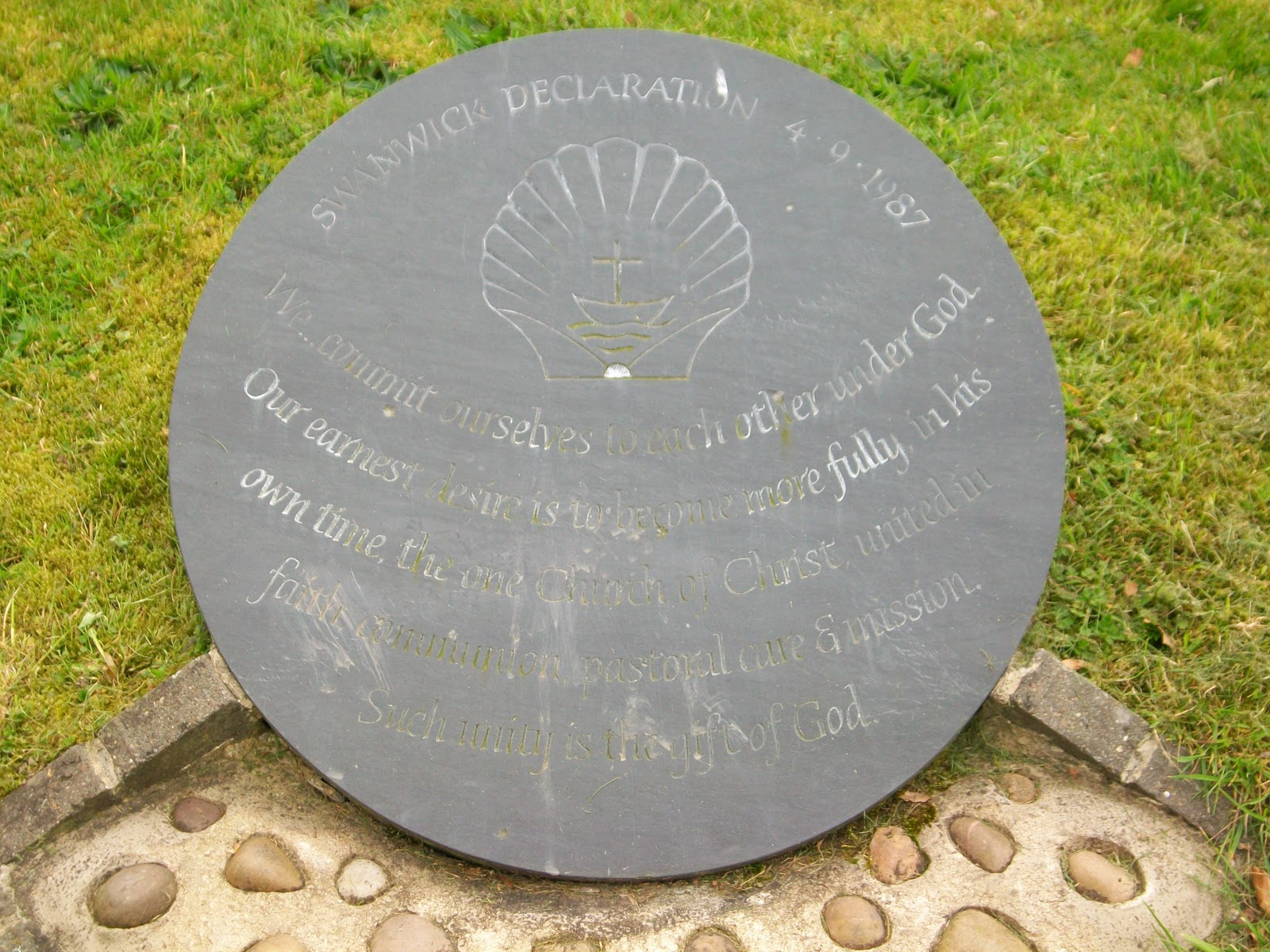
  1. Methodist view of the Swanwick Declaration - the churches in Scotland are reviewing progress with the Swanwick Declaration.
  2. Connexional Ecumenism: connecting up denominational, national, regional and local partnerships
  3. Current position and thoughts about Local Ecumenical Partnerships
  4. Review of developments and current issues in Scotland, Wales, England and Europe
  5. Ecumenical Reception (held over from last time)
  6. Joint Implementation Commission including Methodist response to Church of England proposals for extended covenant partnerships, including 
  • recognising and regarding churches
  • revisiting Recognised and Regarded, Authorised and Associate ministries
  • associate status for local preachers / readers
Enhanced by Zemanta

Monday, 7 March 2011

Ecumenical Engagement of the Methodist Church in Wales

Presbyterian Church of WalesImage via Wikipedia
The Methodist Church in Wales is split into two Synods or Districts.  Synod Cymru is Welsh speaking and the Wales Synod is English speaking or bilingual.  Here are some extracts from a paper written in January 2011.

Synod Cymru


Synod Cymru exercises the vast majority of the ministry in Welsh.  Chapel culture is very strong within the Welsh speaking communities in Wales and so it is more natural for Welsh speaking Methodist congregations to form partnerships (which may or may not be formal arrangements  - hence the 'LEP' in commas) are most common with the Presbyterian Church of Wales and with chapels belonging to the Union of Welsh Independent Churches (UWI).  (We should of course remember that the latter is an informal grouping and that chapels which are members of the UWI retain their autonomy - the Union having no oversight or authority over them.)


Synod Cymru has counted about 16 area based partnerships or 'LEPs'. 


Wales Synod


There are about 18 circuit based partnerships as well as 4 chaplaincies in higher education, 4 industrial and workplace chaplaincies, 1 prison chaplaincy and one other.  There are also a couple of training partnerships.


Challenges and difficulties facing ecumenical co-operation
  1. Strategic deployment of ministry.  The difficulty is that we all use different processes and timing patterns in deploying ministry which can lead to frustration between partners, particularly when there is pressure to reduce staff levels, and where there is a different approach to the length and timing of interregnums. 
  2. More limited access to funding to support strategic development.  Restructuring of connexional funding has led to Districts (including the Cymru and Welsh Synods) having to fund what previously was held to be connexional priorities, with a consequent reduction in the financial resources available. 
  3. Changing assessment of key strategic issues.  Faced with this reduced level of funding, we have to make difficult decisions as to where we can continue to support ecumenical ministry schemes.  In some cases this means that given changed circumstances, we can no longer afford to resource some areas of work in the way we once did. 
  4. Different language / cultural settings require different partners.  The language and cultural geography of Wales means that Methodism may look to different partners in different places.  For example, the Wales Synod may look more naturally to the Church in Wales or the URC, whilst Synod Cymru may look to the PCW or UWI as partners.  However, in responding to issues across Wales, we need to remain coherent as a denomination.
Potential areas of new ecumenical work


We suggest that key is to find common areas of mission priority.  These may include:
  1. areas where significant new housing development is planned
  2. areas where chaplaincy work is developing
  3. sharing in new approaches to training for ministry
  4. sharing in other ecumenical mission projects
Enhanced by Zemanta

Wednesday, 2 March 2011

Local Ecumenical Partnerships in Scotland 2010

Logo of the Church of Scotland.Image via Wikipedia
This is the fourth in a series of five posts based on the Methodist Church's report about ecumenical relations in Scotland 2010

We still have only seven formal Local Ecumenical Partnerships (LEPs) in Scotland: Granton Waterfront Churches Centre Project; Livingston Local Ecumenical Parish (with Church of Scotland, Scottish Episcopal Church (SEC) and URC); Grahamston United Parish (with the Church of Scotland and URC); Granton United and Mosspark United (both with the URC); and with the SEC at Rosyth and at St John's Dumfries.  However, there have been some significant developments in local partnerships in 2010 including the following.

Firstly, Granton United Church has been demolished to make way for an affordable housing unit which will include provision for a new church - in the meantime the congregation continue to meet in a local "Seventh Day Adventist" Church building.  It is anticipated the new build may be available by the end of 2011.

Another initiative which is being explored is the possibility of developing a closer relationship between Mosspark United Church and the local Church of Scotland Parish Church.  The Parish Church has recently gone into a ministerial vacancy and there may be an opportunity to build on good relations and the shared worship which takes place over the summer months and at other times.

Through the EMU Partnership we are starting to explore other local initiatives.  One of these is the possibility of deepening a building sharing arrangement in Girvan, where the SEC meet to worship in a Methodist building.  This initiative is still in its early stages of development but could lead to both a shared mission and ministry in Girvan.

The Scottish Churches National Sponsoring Body (NSB) for Local Ecumenical Partnerships continues to develop and maintain guidelines for best practice in LEPs and provides the mechanisms for shared oversight and review of existing LEPs.
Enhanced by Zemanta

Wednesday, 23 February 2011

New Housing Group visits Milton Keynes

Ecumenical Church of Christ the CornerstoneImage via Wikipedia
This is from the latest edition of CTE News.

The new city of Milton Keynes is 40 years old. How has the ‘church’ engaged with ‘new housing’? Are there specific lessons from MK for the wider church? Some members of the Churches Group for New Housing Areas thought that it would be good to visit, listen, reflect and write - even if for short time and in a small area.

MK still expanding
MK is 40 years old but still expanding greatly. The 237k population is projected to be 400k. The main areas of new housing growth are on the east and west sides of the city. Ross Northing, Vicar of the established town of Stony Stratford at the north end of MK, is also Rector of Calverton, a hamlet of 150 souls with a medieval church. The projected new population here is 16,000 and the new housing area will be larger than the old town.

Sense of identity
We heard that many people living in MK have a strong sense of identity with MK as a ‘good place to be’. People frequently move house e.g. 4 times in 7 years, but it often within MK itself. MK ‘identity’ and ‘networks’ across the city are important (more than in the local grid squares). The church also has strong networks across the city: eg ‘Bridge-builders’ in schools; Environment Group; Homeless care etc. Although the sense of identity with MK is strong, issues of mobility and commitment make ‘building community’ difficult (see later).

New church buildings
In response to the enormous housing programme of the 70’s and 80’s, a large number of shared church buildings were built with community facilities. Often sponsored by several denominations, they were LEP’s (Local Ecumenical Projects or Partnerships). We visited ‘Christ the Cornerstone’ (illustrated) in the city centre, and heard: ‘We cannot replicate the church planting of the 1980’s with the resources we have now. We are very grateful for all that has been given in the past and need to ‘up the act’ of our congregation to reach out to new areas now’.

Changed worldview
MK was designed with a modernist 1960’s view – which has changed. ‘Our major issues are the changing social environment, the un-churched, changing ecumenical scene, the new vision of living responsibly, economic pressures and the impetus of ‘how to be church?’, says Mary Cotes, Ecumenical Moderator for MK. ‘We are engaging in Fresh Expressions and pioneer ministers and the question of new church buildings is both yes and no. The idea to re-enact the 60’s/70’s master plan “no”, but new independent churches and ethnic churches may say “yes” as renting community buildings: some have sought land in new build areas’.

Nature of the congregation changed
‘The nature of the congregation has changed dramatically’ says James Cassidy who has returned to the same RC church as parish priest for a second time. ‘The Population in the 1980’s was fairly homogeneous - but now we have 47 nations represented at Mass. The transient population was illustrated when I found that only 12 families remembered me when I returned in 2002’.

Mobility
People in MK move house by a factor of 40% more than in other parts of the country. Last summer 30 Primary Schools had vacancy for Head, and a family centre built in April 2010 is already looking for its second manager. This issue of high mobility raises lots of problems for continuity, especially for volunteer based organizations like the church trying to provide outreach facilities.

Commitment
Another challenge is the geographical spread and ‘lack of consistency’ of people for regular commitment. ‘Consumerism means that people want things provided for them, without much personal cost and commitment’. People respond to one off events rather than ongoing activities. In addition, women’s roles have changed; many families cope with issues of separation; ‘the car is key’, and local activities suffer when people travel elsewhere to get what they want – which is another challenge for a new local church congregation.

Schools and church
A major theme we heard was the importance of schools and church working together on new estates. Schools seemed generally keen for this and appreciated the voluntary help of Christians in many capacities. The Watling Valley Ecumenical partnership, for example, has good working relationships with every school in their area. We visited ‘Christ the Sower’ school and heard about ‘partnership’, from the chaplain Nick Adlem.

Partnership
We kept hearing about the importance of partnership and inter-agency work and networks, especially for children’s, school, family and church work, but also for Local Authorities, planners. We heard examples, eg Age UK, the Parks and Police. This raises questions of personnel, and the capacity for many Christians who feel called to create community with the pressures of ‘mobility’ and ‘commitment’ above.

‘Going with the flow’
‘Capacity’ raised the question of ‘following the organic’ growth. Good working relationships lead to networks and partnership which are mutually beneficial, but may mean developing activities which did not fit a previous plan or intention - often leading to a change of direction. This can be good, but providing ‘consistency’ can be difficult.

Making the most of given resources
We heard of St Giles Tattenhoe - a very small ‘box pew’ 1540’s chapel with no electricity until 2007, which stood in open fields with a local population of 12 people, until surrounded by new housing. A church planting group had previously met in the training room at Morrison’s supermarket as part of the Watling Valley Ecumenical Partnership. After several years St Giles church now has regular congregations offering a range of worship opportunities.

Ongoing questions we heard from local church leaders:
  1. How do church, school and community networks fit in the ‘current ‘big society’ agenda?
  2. How can the worship reflect the diversity of people present?
  3. Partnership is key: but how can it be sustained in a mobile population?
Enhanced by Zemanta