Pages

Tuesday, 8 March 2011

Ecumenism in Ambridge

178Image via Wikipedia
Regular readers will be delighted to hear ecumenism is very much alive in the County of Borsetshire.  Usually we hear little of the churches in Borsetshire, primarily because its best known village, Ambridge, seems to have never accommodated anything other than a parish church.

At the meeting of new ecumenical officers last week, participants examined a case study of Borsetshire and found there was much going on in the surrounding villages and towns.  It appears a County Ecumenical Development Officer post is about to be advertised and I'm sure many of us will be viewing it with a mixture of interest and scepticism.

The new ecumenical officers' training course has undergone a number of staff changes in recent years and consequently, this year a number of new elements were introduced, of which the Borsetshire case study was one.  Overall, there were a number of unexpected emerging themes.

One development was a deepening appreciation of the role of prayer and spirituality in ecumenical work.  The staff have always underlined the need to deploy listening skills and this year, the group explored the importance of presence and using all senses to understand the stories of ecumenical work but also the underlying or hidden narrative, which sometimes needs to be reflected back to local people.

Closely connected was the important insight that the role of the ecumenical officer is more than being a resource for technical know-how.  It is a ministry and can draw on conventional forms of ministry.  Some Ecumenical Officers might draw on pastoral work, for example, or development work.

Here are some of the issues identified by participants on the course:
  • How do we get the right balance between bottom up work with Churches Together groups, for example, and top down constitutions?  Why do we need constitutions?
  • To what extent are emerging churches off the ecumenical radar? 
  • How inclusive are we?  Are we prepared to take risks in relationship forming? 
  • The Global perspective, ecumenism is not restricted to Britain alone.
  • Belonging to an institution and forming relationships beyond it can be a difficult balancing act.  How far can we go?  Does ecumenism embrace groups such as Mormons?
  • What do we do when the institutions cause problems, eg over the ordination of women or sexuality?
NB    For overseas readers, 'The Archers' is a BBC Radio 4 soap, set in Ambridge, Borsetshire.  Please don't confuse this Ambridge with the one in Pennsylvania!  Furthermore this video, demonstrates the central place The Archers has in our national life.


Enhanced by Zemanta

Monday, 7 March 2011

Ecumenical Engagement of the Methodist Church in Wales

Presbyterian Church of WalesImage via Wikipedia
The Methodist Church in Wales is split into two Synods or Districts.  Synod Cymru is Welsh speaking and the Wales Synod is English speaking or bilingual.  Here are some extracts from a paper written in January 2011.

Synod Cymru


Synod Cymru exercises the vast majority of the ministry in Welsh.  Chapel culture is very strong within the Welsh speaking communities in Wales and so it is more natural for Welsh speaking Methodist congregations to form partnerships (which may or may not be formal arrangements  - hence the 'LEP' in commas) are most common with the Presbyterian Church of Wales and with chapels belonging to the Union of Welsh Independent Churches (UWI).  (We should of course remember that the latter is an informal grouping and that chapels which are members of the UWI retain their autonomy - the Union having no oversight or authority over them.)


Synod Cymru has counted about 16 area based partnerships or 'LEPs'. 


Wales Synod


There are about 18 circuit based partnerships as well as 4 chaplaincies in higher education, 4 industrial and workplace chaplaincies, 1 prison chaplaincy and one other.  There are also a couple of training partnerships.


Challenges and difficulties facing ecumenical co-operation
  1. Strategic deployment of ministry.  The difficulty is that we all use different processes and timing patterns in deploying ministry which can lead to frustration between partners, particularly when there is pressure to reduce staff levels, and where there is a different approach to the length and timing of interregnums. 
  2. More limited access to funding to support strategic development.  Restructuring of connexional funding has led to Districts (including the Cymru and Welsh Synods) having to fund what previously was held to be connexional priorities, with a consequent reduction in the financial resources available. 
  3. Changing assessment of key strategic issues.  Faced with this reduced level of funding, we have to make difficult decisions as to where we can continue to support ecumenical ministry schemes.  In some cases this means that given changed circumstances, we can no longer afford to resource some areas of work in the way we once did. 
  4. Different language / cultural settings require different partners.  The language and cultural geography of Wales means that Methodism may look to different partners in different places.  For example, the Wales Synod may look more naturally to the Church in Wales or the URC, whilst Synod Cymru may look to the PCW or UWI as partners.  However, in responding to issues across Wales, we need to remain coherent as a denomination.
Potential areas of new ecumenical work


We suggest that key is to find common areas of mission priority.  These may include:
  1. areas where significant new housing development is planned
  2. areas where chaplaincy work is developing
  3. sharing in new approaches to training for ministry
  4. sharing in other ecumenical mission projects
Enhanced by Zemanta

Friday, 4 March 2011

EMYC | European Methodist Youth and Children's Council

I've just updated some brief notes about EMYC | European Methodist Youth and Children's Council for the Methodist Church website.  There are links to the Methodist churches in Europe on the website because it is through the European Methodist Council and its associated bodies that the Methodist Church of Great Britain relates to churches of other traditions in Europe.

EMYC has an International Mission Team (IMT) and this is what I want to focus upon in this blog post.  Details can be found on the EMYC website and there is also an IMT blog which, although it is in German, has some photographs.

Four young people are recruited each year to this team.  They start in September and work as volunteers in Chemnitz, Germany through to June of the following year. 

For 2011-12

We are looking for young people from 18 years old who want to walk a special path with God and encounter people with God’s love. As it will be an international team, it is very important to be prepared to be open to others and to be able to work with other mentalities. Alongside the main projects, the year offers many opportunities and room for developing and implementing your own ideas for social outreach and mission work.

The Team will work mainly with children, young people and families. The main focus of the work will lie in social outreach. The team will look after and expand Kidsclub in Chemnitz/Hilbersdorf and Flöha, where the kids can receive help with their homework, have the chance to do something meaningful with their freetime, and also encounter the love of God. The main goal of the Kidsclubs is to offer the attention and acceptance that the children, from socially difficult areas, so desperately lack.  Furthermore, the Team will support the Mission Projects of the Churches and of the Hospital. Through this we can build the Kingdom of God.

For the Team members the year offers the opportunity to discover God in new ways, to grow in faith, to take part in social and mission projects, and to discover a new country and a new way of life.
  • Time: 1th September 2011 til 30th June 2012
  • Where: Methodist Circuit Chemnitz-Erlöserkiche, Hospital and School of Nursing Bethanien/Chemnitz
  • Size of Team: 4 People
  • Status: Voluntary Workers
  • Language: Basic knowledge of German necessary -fluent German not required
  • Accommodation: will be provided
  • Food: weekdays lunch in Bethanien and €100 per month for groceries
  • Pocket Money: €75 per Month per Person
  • Closing Date for application: 31th March 2011
For more information, go to this page on the EMYC website.  If a British Methodist applies and is successful, it would be good to hear from them and perhaps they could contribute to this blog.
Enhanced by Zemanta

Thursday, 3 March 2011

Episcopal, Methodist and URC Discussions

St Ninian's Cathedral, Perth, Perth and Kinros...Image via Wikipedia
This is the last of five posts of the Ecumenical Relations in Scotland report to the Methodist Church, 2010. 

The Episcopal, Methodist, URC (EMU) Partnership agreement was signed on 23 January 2010 in the Scottish Episcopal Church (SEC) Cathedral in Perth.  The partnership sets out to explore together ways of:
Being Church and serving God together;
  • Increasing the confidence of our members to speak of God and faith in ways that make sense to others;
  • Cooperating in teaching and learning about Jesus Christ, and our mission together;
  • Cooperating on Church and Society issues, supporting community development and taking action together for justice, especially among the most deprived and poor in Scotland;
  • Sharing in the provision and deployment of both lay and ordained ministries of all the people of God;
  • Sharing our resources across Scotland to fulfil our shared Christian mission to spread the Gospel.
Copies of the full agreement are now with each church and the onus is on local congregations as well as the national level if this relationship is to develop.

The EMU group met twice in 2010 with the main focus being the fleshing out of a  development plan, developing a "Federation" on training / learning together and exploring other possibilities for co-operation both locally and nationally.  With Welsh and Scottish Episcopal Church participation in the Joint Implementation Commission (JIC) 2 of the Anglican Methodist Covenant, EMU provides a possible vehicle for taking forward initiatives arising in this forum within Scotland, as the URC also participate in JIC2.
Enhanced by Zemanta

Wednesday, 2 March 2011

Local Ecumenical Partnerships in Scotland 2010

Logo of the Church of Scotland.Image via Wikipedia
This is the fourth in a series of five posts based on the Methodist Church's report about ecumenical relations in Scotland 2010. 

We still have only seven formal Local Ecumenical Partnerships (LEPs) in Scotland: Granton Waterfront Churches Centre Project; Livingston Local Ecumenical Parish (with Church of Scotland, Scottish Episcopal Church (SEC) and URC); Grahamston United Parish (with the Church of Scotland and URC); Granton United and Mosspark United (both with the URC); and with the SEC at Rosyth and at St John's Dumfries.  However, there have been some significant developments in local partnerships in 2010 including the following.

Firstly, Granton United Church has been demolished to make way for an affordable housing unit which will include provision for a new church - in the meantime the congregation continue to meet in a local "Seventh Day Adventist" Church building.  It is anticipated the new build may be available by the end of 2011.

Another initiative which is being explored is the possibility of developing a closer relationship between Mosspark United Church and the local Church of Scotland Parish Church.  The Parish Church has recently gone into a ministerial vacancy and there may be an opportunity to build on good relations and the shared worship which takes place over the summer months and at other times.

Through the EMU Partnership we are starting to explore other local initiatives.  One of these is the possibility of deepening a building sharing arrangement in Girvan, where the SEC meet to worship in a Methodist building.  This initiative is still in its early stages of development but could lead to both a shared mission and ministry in Girvan.

The Scottish Churches National Sponsoring Body (NSB) for Local Ecumenical Partnerships continues to develop and maintain guidelines for best practice in LEPs and provides the mechanisms for shared oversight and review of existing LEPs.
Enhanced by Zemanta

Tuesday, 1 March 2011

Training Course for Ecumenical Officers

Today marks the first day of the annual ecumenical training course for ecumenical officers.  It is organised by Churches Together in England (CTE) and Cytun.  It is an opportunity for County and Denominational Ecumenical Officers who have just taken up the role, to learn something of the basics.

One important aspect of the course is the presence of most of the National Ecumenical Officers as well as staff from CTE and Cytun.  This is an opportunity for new people to put faces to names and learn something of the issues that are current amongst the officers.

The course has four main dimensions:
  1. The core of the course is a visit to an ecumenical project.  This takes up most of the second day, with preparation, the visit and a debrief.  This year there are four destinations for visits: Mission in the Economy, Liverpool Seafarers' Centre, Fourth Dimension Churches' Shop, Church of the Resurrection and of St Bridgets.
  2. There is a taught section of the course which looks at the role of the ecumenical officer and some of the hot topics are challenging ecumenical officers today.  This year these include new ecumenism (relationships with new churches), relationships with new black churches and the role of Intermediate Bodies.
  3. There is time in denominational groups, so that each type of officer receives some input about their own tradition.  The County Officers have their own group about their own distinct role.
  4. There are a number of worship sessions that include opportunities to experience worship from various traditions, as well as ecumenical worship.
Enhanced by Zemanta

Monday, 28 February 2011

Action for Churches Together in Scotland Networks 2010

The Holy and Undivided TrinityImage by Lawrence OP via Flickr
In the Methodist report on Ecumenical Relations in Scotland 2010, there is a long section about Action for Churches Together in Scotland (ACTS).  This post is devoted to its networks.

ACTS Mission Network

During 2010 the Mission Network published its review titled "Through the Keyhole" which focused on the state of our churches and their place in our communities both through the eyes of church goers but also of the "unchurched".  The report highlighted some interesting observations although most reflect other studies.  "Being Church in Areas of New Development" has continued to be a major focus of the ACTS Mission Network's activities through 2010.  New work being undertaken includes: "Mission Shaped Church" with a specific initiative being "Cafe Church" on which a couple of courses have been run and an embryo network of those interested established.  This Network is also starting to take an interest in "More than Gold" the Churches response to the 2012 Olympic Games in preparation for the Glasgow Commonwealth Games in 2014.

ACTS Church and Society Network

The ACTS C and S Network continues to cover a very broad agenda.  The Network continues to service and support a wide range of Associated Ecumenical groups and Bodies in Association.  Significant areas of work during 2010 have included:
  • A group looking at issues that the Scottish Gypsy "Travellers" have with the Church
  • A group looking at the War in Afghanistan - through concepts of "Just War"
  • The launch of the "Minority Ethnic Christians Together in Scotland" as a grouping of around 50 existing minority ethnic Christian groups
  • A conference on "Spiritual Care in Higher Education"
  • An exploration of Chaplaincy in the National Health Service
  • Material for the 2011 Scottish Parliamentary Elections.  This includes guidance on how to handle extremist groups (specifically those deemed to be racist) based on Methodist material.
ACTS Faith Studies Network

A booklet on the Holy Trinity which the Faith Studies Network endorsed and published and placed on the website raised significant discussion during the year.  While the members of the Network (including Roman Catholics) hope that it will be used by ecumenical and other groups to explore the issues and to improve their understanding of the place which the Trinity holds in their Churches' worship and doctrine the text has led to much anguish especially with the Roman Catholics.  This issue illustrated the difficulty in ACTS speaking with one mind on any particular issue and while generally accepted that debate is healthy it can add some tensions between denominations on specific issues.

ACTS Church Life Network

In 2010 the Methodist Church through Rev John Butterfield took on the Convenorship of the Church Life Network.  The "Back to Church Sunday" initiative continues to be one aspect of this Network's work as does the material on the ACTS website for "A Quiet Day for Scotland" 2010.  The Week of Prayer for Christian Unity took as a theme for 2010 the centenary of the 1910 World Missionary Conference and this Network engaged in the production of this material.  A new Associated Ecumenical Group to this network is the "Scottish Churches Disability Action Group" which had its launch in 2010 and is starting to develop an agenda for greater involvement of disabled people in Scottish Church.  John Butterfield has also been instrumental in producing through this group the Easter 2011 worship material for ACTS.
Enhanced by Zemanta

Friday, 25 February 2011

Action of Churches Together in Scotland (ACTS)

St.Monans Church ScotlandImage by Florian Seiffert (F*) via Flickr
This is another extract from the Methodist Church's Ecumenical Relations report for Scotland, 2010.  This post focuses upon the role of Action of Churches Together in Scotland (ACTS). 

Through most of the year the ACTS Members Meeting managed to focus on the shared mission of the churches in Scotland, leaving the Trustees to manage the ecumenical instrument.  However, with the re-emergence of Scottish Churches House financial crisis later in the year the focus of both the Trustees and members meeting returned to resolving the SCH issues.

Significant mission initiatives supported through the year included:
  • Edinburgh 2010 (with the secondment of the ACTS General Secretary)
  • Various events around a visit from the World Council of Churches Executive Committee
  • Back to Church Sunday promotion
  • A conference on "Working with Children in the Church Community"£
  • A conference on "The Spiritual Journey in old Age"
  • A conference to discuss "Spiritual Care in higher Education"
  • Training for Congregational Disability Champions
  • The launch of the Minority Ethnic Christians Together in Scotland (MECTIS) an association of around 50 ethnic minority Christian groups
  • Ecumenical Mediation and the outcomes of a Church of Scotland led Conference on "Christianity, Conflict and the Soul of the nation"
  • Arrangements for the visit of Pope Benedict XVI to Scotland
  • Early preparation for the Churches response to the Scottish parliamentary elections in 2011
  • The development of networks across the churches to support "Pilgrim Paths"
  • The "Quiet Time for Scotland" initiative - a time for prayer around St Andrews Day
  • A review of ecumenism in Scotland using the Australian Churches Covenanting Together process and facilitated with "Quaker" style clerking.
In a very busy year, due to Edinburgh 2010 and the ongoing crisis with Scottish Churches House, the ACTS staff have done stalwart work in supporting all these new initiatives alongside servicing the 4 Networks and a wide range of Associated Ecumenical Groups.

We'll take a look at the 4 Networks in a future post.
Enhanced by Zemanta

Thursday, 24 February 2011

The Methodist Church in Scotland Ecumenical Relations Report 2010

This is the first of five extracts from the Methodist Church's Ecumenical Relations Report for Scotland.  The author is Dr Bill Reid, who is responsible for ecumenical relations in the Scotland District.  More information about Scotland's ecumenical relations can be found on the Methodist Church website.

2010 has been a year of significant anniversaries for the Churches in Scotland.  As well as being the 450 anniversary of the Reformation in Scotland, the year has also included the 100 anniversary of the 1910 Mission Conference held in Edinburgh (credited with initiating the Ecumenical Movement) and the 50 anniversary of Scottish Churches House.  These three anniversaries highlight both great progress made in ecumenical relationships but also the inherent challenges we all still face in serving Christ together in today's Scotland.

The Reformation in Scotland
Much of the commemorations to mark the 450 years since the Reformation were understandably led by the Church of Scotland engaging in key services, conferences and other events with the Roman Catholic Church, the Scottish Episcopal Church and civic society.  These events were well managed and at times moving but seemed to make little impact on our wider society.  It is worth noting that for some of us it appeared the other denominations in Scotland were marginalised in many of these events.  Also with such a close focus on what took place in Scotland 450 years ago  the opportunity to see "Reformation" as an ongoing process across the nations rather than an event was largely lost.  That said the reaffirmation of Baptismal vows shared between the leaders of the three denominations illustrated how much progress has been made in their relationship in recent years.

1910 Mission Conference

On the world stage Edinburgh 2010, a conference entitled "Witnessing to Christ Today", was initiated by the World Council of Churches to celebrate the "Great Mission Conference of 1910".  Whereas the Conference of 1910 was largely attended by white male reformed church ministers and missionaries, Edinburgh 2010 was far more inclusive bringing delegates from all over the world to Edinburgh.  Initially planned for over 1000 delegates the final number was nearer 200 (largely through planning and financial constraints).  It was very pleasing to see people of many races (women and men) and from a broad spectrum of theologies including catholic, orthodox and evangelicals.  The main focus was on an academic conference which somewhat disappointingly did not engage with the wider church let alone society in general.  That said much of the Conference was transmitted on the internet.  The highlight for many was the closing worship when over a thousand shared in a joyous almost 3 hour events in the Church of Scotland General Assembly Hall on 6 June.  If the energy that was generated that afternoon could be replicated across Scotland our churches would not be struggling for membership.

Scottish Churches' House

Closer to home for the Methodist Church in Scotland is Scottish Churches' House (SCH), in Dunblane, where we currently have our offices.  SCH dates back beyond 1950 when a large number of then relatively young Christians worked together to establish and refurbish the House out of various properties that came together from various sources.  SCH became the main focus for ecumenical action in Scotland and has been loyally supported over the years.  The founding of the House was celebrated on 17 July with several of those involved at its outset still supporting the House at what was a joyous occasion.  Sadly, although a major refurbishment has recently been completed and SCH still attracted its loyal supporters the user base had continued to age and decline to such a point that the new Charity being set up to run the House judged that its current operation is no longer viable.  As a result of ongoing financial loss the trustees of Action of Churches Together in Scotland (ACTS) have decided to cease its current operation on 16 July 2010 but rather than sell the SCH properties immediately has invited tenders to rent the House from ACTS and run it a way compatible with the ACTS objectives.  So while the future of SCH is uncertain we should pray that a fresh vision for it emerges over the next few months.  We should also hold in our prayers at this difficult time the staff and supporters of the House who have contributed so much to its success and continued witness over more than 50 years.
 
Enhanced by Zemanta

Wednesday, 23 February 2011

New Housing Group visits Milton Keynes

Ecumenical Church of Christ the CornerstoneImage via Wikipedia
This is from the latest edition of CTE News.

The new city of Milton Keynes is 40 years old. How has the ‘church’ engaged with ‘new housing’? Are there specific lessons from MK for the wider church? Some members of the Churches Group for New Housing Areas thought that it would be good to visit, listen, reflect and write - even if for short time and in a small area.

MK still expanding
MK is 40 years old but still expanding greatly. The 237k population is projected to be 400k. The main areas of new housing growth are on the east and west sides of the city. Ross Northing, Vicar of the established town of Stony Stratford at the north end of MK, is also Rector of Calverton, a hamlet of 150 souls with a medieval church. The projected new population here is 16,000 and the new housing area will be larger than the old town.

Sense of identity
We heard that many people living in MK have a strong sense of identity with MK as a ‘good place to be’. People frequently move house e.g. 4 times in 7 years, but it often within MK itself. MK ‘identity’ and ‘networks’ across the city are important (more than in the local grid squares). The church also has strong networks across the city: eg ‘Bridge-builders’ in schools; Environment Group; Homeless care etc. Although the sense of identity with MK is strong, issues of mobility and commitment make ‘building community’ difficult (see later).

New church buildings
In response to the enormous housing programme of the 70’s and 80’s, a large number of shared church buildings were built with community facilities. Often sponsored by several denominations, they were LEP’s (Local Ecumenical Projects or Partnerships). We visited ‘Christ the Cornerstone’ (illustrated) in the city centre, and heard: ‘We cannot replicate the church planting of the 1980’s with the resources we have now. We are very grateful for all that has been given in the past and need to ‘up the act’ of our congregation to reach out to new areas now’.

Changed worldview
MK was designed with a modernist 1960’s view – which has changed. ‘Our major issues are the changing social environment, the un-churched, changing ecumenical scene, the new vision of living responsibly, economic pressures and the impetus of ‘how to be church?’, says Mary Cotes, Ecumenical Moderator for MK. ‘We are engaging in Fresh Expressions and pioneer ministers and the question of new church buildings is both yes and no. The idea to re-enact the 60’s/70’s master plan “no”, but new independent churches and ethnic churches may say “yes” as renting community buildings: some have sought land in new build areas’.

Nature of the congregation changed
‘The nature of the congregation has changed dramatically’ says James Cassidy who has returned to the same RC church as parish priest for a second time. ‘The Population in the 1980’s was fairly homogeneous - but now we have 47 nations represented at Mass. The transient population was illustrated when I found that only 12 families remembered me when I returned in 2002’.

Mobility
People in MK move house by a factor of 40% more than in other parts of the country. Last summer 30 Primary Schools had vacancy for Head, and a family centre built in April 2010 is already looking for its second manager. This issue of high mobility raises lots of problems for continuity, especially for volunteer based organizations like the church trying to provide outreach facilities.

Commitment
Another challenge is the geographical spread and ‘lack of consistency’ of people for regular commitment. ‘Consumerism means that people want things provided for them, without much personal cost and commitment’. People respond to one off events rather than ongoing activities. In addition, women’s roles have changed; many families cope with issues of separation; ‘the car is key’, and local activities suffer when people travel elsewhere to get what they want – which is another challenge for a new local church congregation.

Schools and church
A major theme we heard was the importance of schools and church working together on new estates. Schools seemed generally keen for this and appreciated the voluntary help of Christians in many capacities. The Watling Valley Ecumenical partnership, for example, has good working relationships with every school in their area. We visited ‘Christ the Sower’ school and heard about ‘partnership’, from the chaplain Nick Adlem.

Partnership
We kept hearing about the importance of partnership and inter-agency work and networks, especially for children’s, school, family and church work, but also for Local Authorities, planners. We heard examples, eg Age UK, the Parks and Police. This raises questions of personnel, and the capacity for many Christians who feel called to create community with the pressures of ‘mobility’ and ‘commitment’ above.

‘Going with the flow’
‘Capacity’ raised the question of ‘following the organic’ growth. Good working relationships lead to networks and partnership which are mutually beneficial, but may mean developing activities which did not fit a previous plan or intention - often leading to a change of direction. This can be good, but providing ‘consistency’ can be difficult.

Making the most of given resources
We heard of St Giles Tattenhoe - a very small ‘box pew’ 1540’s chapel with no electricity until 2007, which stood in open fields with a local population of 12 people, until surrounded by new housing. A church planting group had previously met in the training room at Morrison’s supermarket as part of the Watling Valley Ecumenical Partnership. After several years St Giles church now has regular congregations offering a range of worship opportunities.

Ongoing questions we heard from local church leaders:
  1. How do church, school and community networks fit in the ‘current ‘big society’ agenda?
  2. How can the worship reflect the diversity of people present?
  3. Partnership is key: but how can it be sustained in a mobile population?
Enhanced by Zemanta

Tuesday, 22 February 2011

Church Leaders to ask David Cameron to Pledge to Close the Gap

This article from the February 2011 edition of CTE News builds on a great deal of ecumenical work addressing poverty.  Some have been reported on this blog, see the links below.  There is also a report of this event on Praxis.

On 31 January, church leaders of all denominations gathered in Westminster and made a public Pledge: that their churches will spend the next three years working to tackle UK poverty and inequality.

At the start of Poverty and Homelessness Action Week, national leaders from all the UK’s largest denominations were at 10 Downing Street, accompanied by MPs of the All-Party Parliamentary Group on Poverty, and representatives of the charity Church Action on Poverty.

They handed in a letter to David Cameron, expressing their commitment to Close the Gap between rich and poor, and asking about the Coalition Government’s plans to do the same. In the letter, they say:

As Christians in leadership positions within our respective denominations and organisations, we consider it is our duty to speak up on behalf of the poorest and most vulnerable – especially at a time when they are suffering the consequences of the economic crisis and public spending cuts…

We understand the many pressures you are under, and that the Coalition is committed to reducing the public deficit over the current parliament. But tackling inequality is not something that can be put off for the ‘good times.’

We would therefore like to invite you – and your fellow ministers in the Coalition Government – to make a public Pledge to take action to close the gap between rich and poor in the UK.

The leaders who have signed the letter are:
  • Rt Revd David Walker, Bishop of Dudley, on behalf of the Church Urban Fund
  • Revd Sivakumar Rajagopalan, Regional Minister(Racial Justice) of London Baptist Association, on behalf of the Baptist Union
  • Paul Marriott, Chief Executive of Depaul UK, on behalf of Vincentians in Partnership
  • Frances Ballin National Executive member of the Roman Catholic National Justice and Peace Network
  • Revd Leo Osborn, President-Designate of Methodist Conference, on behalf of the Methodist Church
  • Christy-Anna Errington, Methodist Youth President, on behalf of the Methodist Church
  • Revd Frank Kantor, Secretary for Church and Society, United Reformed Church
  • Niall Cooper, National Coordinator of Church Action on Poverty
David Walker, Bishop of Dudley and trustee of the Church Urban Fund, commented: 'The God who meets us in Jesus, calls us to meet and serve each other, yet the gap between the well off and the poor has become so wide that few bridge it. Unless we work to ‘Close the Gap’, the vision of a Big Society will never get off the drawing board.'

The event marks the launch of a major three-year campaign for Church Action on Poverty: Pledge to Close the Gap. We are asking churches and Christians everywhere to follow the example of these church leaders, and make their own Pledges to Close the Gap. We’ll be offering a range of simple Pledges for people to make, in three areas: Give, Act and Pray. The campaign will go live during Poverty & Homelessness Action Week, with online Pledges at http://www.church-poverty.org.uk/, a major publicity campaign in the church press, and Pledge actions at church events throughout the year.
Enhanced by Zemanta

Monday, 21 February 2011

Women’s World Day of Prayer

Another item from the CTE News for February 2011:

On Friday March 4th 2011 women from around the world will celebrate the Women’s World Day of Prayer. The service has been written by the women of Chile. 'How many Loaves Have You'  is an appropriate theme for bread is eaten at every meal and is very much part of every day life. The women of Chile offer what it means to them as they share this service with us.

Jean Hackett, president of the National Committee of the Women’s World Day of Prayer Movement, said: ‘This is always an exciting day as a great wave of prayer sweeps the world, beginning when the first service is held in Tonga and continuing around the world until the final service takes place, some 35 hours later, in neighbouring Western Samoa. By then the day will have been celebrated in over 170 countries and over 5,000 services will have been held in England, Wales and Northern Ireland.’

Stretching from Peru to Antarctica, the Republic of Chile occupies a long, narrow strip of land 2,640 miles long and 110 miles wide. It is a land of incredible contrasts. It also has the highest incidence of domestic violence in Latin America and most women suffer from discrimination in some form or other. Equal opportunities are being pursued. Although organised and led by women, this is essentially a day of prayer for everybody as we demonstrate our solidarity with our sisters and brothers in other countries and all are welcome to attend. Visit the WWDP website for further information and resources, together with details of services in your area.

Friday, 18 February 2011

The Big Lunch: 5th June

The Big Lunch, Coal Aston, DerbyshireImage by Andrew Walker 36 via Flickr
Here is another item from the February edition of CT News.  The Big Lunch is a 'wild seed' of the Eden Project, who appear to be breeding dinosaurs in Cornwall.

The Big Lunch is back with a bang! This years' event is taking place on Sunday 5th June so now's the time to start planning. Go to the 2011 Big Lunch website today so that you can be the first to register your event and get a handy Organiser's Pack in the post. The packs will give you everything that you need to start planning your event, from invites and recipe ideas to badges and balloons.

If you intend to hold a big event with over 50 people and you'd like to apply for some funding to help make it possible, the Big Lottery Fund Awards for All scheme could be just what you need. Small grants are given out throughout the year to help people make a difference to their community.

There are certain requirements that you have to meet in order to apply - you must be a community or not for profit group, a Parish or Town Council, a Health body or a school - and to get funding in time for your Big Lunch, you need to get your application in soon. It would be a good activity for a Churches Together group or LEP.
Enhanced by Zemanta

Thursday, 17 February 2011

New Leader Marks New Beginnings for The Corrymeela Community

This article from the February 2011 edition of CTE News includes news of a past President of Methodist Conference.  In the photo, Inderjit (centre) unveils a plaque, in November 2010, for the first interfaith tree in his home community, Burngreave, Sheffield.

The Corrymeela Community, Northern Ireland's leading peace building organisation, has appointed a new Leader to take it into the next decade. Following the death of its Leader and Chief Executive Dr David Stevens last May, the Community has appointed Rev Dr Inderjit Bhogal OBE, as his successor.

Kate Pettis MBE, Interim Leader of the Corrymeela Community said, "Inderjit brings to us gifts in abundance. His life's work, informed by Christian principles, has been centred on peace building and is evidenced in his commitment to the building of inter-faith relationships and to working for the achievement of racial justice. We believe our vision for the future which inspired the creation of Corrymeela is safe in his hands and we look forward to his leadership."

A Methodist minister, theologian and former President of the British Methodist Conference, Dr Bhogal has been Chief Executive of the Yorkshire and Humber Faiths Forum and United Faiths - its youth council - since 2005. Inderjit is also the Chair and founder of the much acclaimed City of Sanctuary, a national movement committed to building a culture of welcome and hospitality for people seeking sanctuary in the UK.

Of accepting the role, Inderjit said "David has left a great legacy. I am privileged to succeed him and delighted to accept his role. Diversity is much more complex now. Future peace in Northern Ireland will grow from the ability of people from many different traditions to accommodate their differences and build on their similarities. I am looking forward to life and ministry in Northern Ireland and being part of the future of Corrymeela."

Wednesday, 16 February 2011

Grow Zones – get your community growing

Permacultural aspect: helping animals in a veg...Image via Wikipedia
Churches Together in England is promoting Grow Zones.  There have been many similar community gardening schemes over the years and they can be very rewarding.

How can you combine growing your own delicious food, making new friends, learning a natural growing method, and the opportunity to reconnect at a deep, spiritual level with creation? The answer is Grow Zones, a community growing project being launched through local churches across the UK.

Designed specifically with churches in mind, Grow Zones provides an opportunity to engage new people from your neighbourhood in a simple, practical project that bears on our common concern for the earth.

The idea is very simple. Someone from a local church or neighbourhood hears about Grow Zones and, with the aid of the Grow Zones kit, forms a local team. People are introduced to a natural growing method known as Permaculture and helped to redesign their gardens so they can grow more of their own fruit and veg. Each team is offered insurance as part of the package, and sets out on a series of visits, where they work on one another’s gardens to make their dreams real. The commitment is deliberately light just four mornings make up the whole course, but experience shows that deep bonds form between people, lasting friendships are made and many go on to experience and learn more.

One participant said having experienced Grow Zones: “I don’t know what it was; the sunshine, the friendship, the labour, the food, the fresh air, but my spirits were uplifted and I spent the rest of the day on a high. This morning I came downstairs and felt compelled to go out into the garden. It looked lovely.”

Start a Grow Zones Team

Would you be interested in starting a group in your area? You don’t necessarily need to have any gardening experience, all you need is to be good at organising and encouraging people. If you can gather a group of people together, the Grow Zones Kit will provide the help and resources to get you growing for your first season.

Grow Zones is a national project - supported by the Local Food fund - and a series of Christ and the Earth retreat days supports the programme. To book a retreat day and find out more about the community behind Grow Zones visit http://www.earthabbey.com/.

Case study: One person’s story

I have longed to do something really positive about caring for creation. As part of the Grow Zones pilot in Bristol, and being introduced to Permaculture, I have been set on a fascinating journey that has transformed my view of the world we live in and resulted in my becoming involved in a whole set of community growing projects here in Bristol. It seems to me that reconnecting with the land, and with growing our own food, is an extraordinarily powerful means to help us reconsider how we are living and to build fresh expressions of community life. There was a sort of implicit and deep spirituality that pervaded our experience of Grow Zones here in Bristol, as if God was there among us as we worked together. As a Christian minister, I have also been concerned to express concern for creation in a way that is more than theory, or just ‘doing without’ something. It seems to me that the great biblical hope for peace and harmony in creation finds real expression in the hearts of those who join together in a project like Grow Zones.
Enhanced by Zemanta

Tuesday, 15 February 2011

Mary: Grace and Hope in Christ

Assumption of the Virgin Mary (Rubens)Image via Wikipedia
Those of you who were following last week's meeting of the Church of England's General Synod, may have heard there was a debate about the Virgin Mary.  This was based upon a paper prepared by Anglican Roman Catholic International Commission (ARCIC), Mary: Grace and Hope in Christ.  The following article is from the Council for Christian Unity's (CCU) Bulletin.

In February 2008, General Synod requested that the ARCIC II Reports not already considered by Synod should be debated. Church as Communion came before Synod in February 2009 and Life in Christ was the subject of group work in July 2009. The debate on the remaining report, Mary: Grace and Hope in Christ, took place at last week’s General Synod.

Part of the motion passed by the Synod ‘encourage(s) Anglicans to study the report with ecumenical colleagues and in particular, wherever possible, with their Roman Catholic neighbours’. Dioceses and Parishes are therefore being urged to follow up this part of the motion.

The full motion moved by The Chair of the Council for Christian Unity (The Bishop of Guildford (The Rt Revd Christopher Hill)), was as follows:
‘That this Synod, affirming the aim of Anglican – Roman Catholic theological dialogue “to discover each other’s faith as it is today and to appeal to history only for enlightenment, not as a way of perpetuating past controversy” (Preface to The Final Report, 1982), and in the light of recent steps towards setting up ARCIC III:
  1. note the theological assessment of the ARCIC report Mary: Grace and Hope in Christ in the FOAG briefing paper GS 1818 as a contribution to further dialogue;
  2. welcome exploration of how far Anglicans and Roman Catholics share a common faith and spirituality, based on the Scriptures and the early Ecumenical Councils, with regard to the Blessed Virgin Mary;
  3. request that, in the context of the quest for closer unity between our two communions, further joint study of the issues identified in GS 1818 be undertaken – in particular, the question of the authority and status of the Roman Catholic dogmas of the Immaculate Conception and the Assumption of the Blessed Virgin Mary for Anglicans; and
  4. encourage Anglicans to study the report with ecumenical colleagues and in particular, wherever possible, with their Roman Catholic neighbours.’
You can download the order paper, giving full details of the motion and amendments tabled (all of which were rejected). The motion was passed decisively, following a good quality debate, by a show of hands. The papers supporting the debate, including the text of the report, can be downloaded by clicking on these links:

GS 1818 Briefing paper by FOAG on ARCIC II - Mary: Grace and Hope in Christ
GS Misc 872 FOAG Essays on ARCIC II - Mary: Grace and Hope in Christ
ARCIC II - Mary: Grace and Hope in Christ (original text)

These papers should be used as resources for studying the report, and the Church of England’s response to it, at Diocesan and Parish level. The Briefing Paper (GS 1818) gives a very succinct and useful summary of the report, as well as setting out both its positive aspects and those areas where further work is needed. The FOAG Essays (GS Misc 872) provide an in depth discussion of major themes in the report. The essays come from the full range of perspectives from within the Church of England, and are constructively critical.

In addition, the debate itself could be used as resource. In due course a transcript will be published on the Church of England website, but the audio file of the debate (Wednesday 9th February 2011, item 18) can be downloaded.

Prior to the debate, the Right Revd Christopher Hill introduced the Auxiliary Bishop of the Archdiocese of Westminster, the Right Revd George Stack, who presented a perspective form the Roman Catholic Church, in which he emphasised Pope John Paul II’s call for further study and discernment on the Blessed Virgin Mary. The audio file of Bishop George Stack’s address and Bishop Christopher Hill’s response can be downloaded.

Here are some suggestions for following up the motion in the Dioceses:
  • Make the General Synod Motion known to the senior staff of the diocese (a copy of the motion will also be sent to Diocesan Secretaries) for them to consider how to follow it up;
  • Approach your counterparts in partner Churches (especially the Roman Catholic Diocesan Ecumenical Officer) to discuss how the report may be studied ecumenically at intermediate and parish level.
  • Encourage parishes and deaneries, in which you are aware of a good relationship with Roman Catholic parishes, to study the report together. Remember that our other ecumenical partners may be keen also to participate.
  • A number of dioceses have successfully held study days with Roman Catholic colleagues. If you are interested in finding out more how they have approached this, please contact me.
  • At parish level, where relationships are developing well, considering issues where there are significant differences between churches, requires careful handling. The principles of Receptive Ecumenism are important here. Where there is respect, generosity and the willingness to listen and learn, such conversations can be very rewarding. If any of you have had particular experience of facilitating such conversation at parish level, it would be good to hear from you, in order to flag up examples of good practice.
Finally, here are details about ARCIC III, the areas it will cover, and details of its Anglican and Roman Catholic members.

It would be interesting to hear from Methodists who are involved in these or similar conversations.  If you are interested in participating, the place to start would be to contact your Diocesan Ecumenical Officer.
Enhanced by Zemanta

Monday, 14 February 2011

New Ecumenism

Benutzer:dapete and Benutzer:Ezrimerchant shak...Image via Wikipedia
This is an appeal for information.  There is a request from members of the Connexional Team for news of New Ecumenism, that is Methodist Churches working in partnership with new churches. 

Examples of new churches might include be the Pioneer Networks, independent or house churches and of course Fresh Expressions.  We would also be interested to hear of  partnership working with churches not traditionally involved in ecumenical work, such as the black majority churches. 

If you have any accounts, send them to the Assistant Ecumenical Officer.  Suitable stories will be circulated amongst ecumenical staff on the team.  There is a possibility, with the senders' agreement, to feature these stories on Methodist Ecumenical News.  If that is a possibility, it would be good to have some photos or videos too.
Enhanced by Zemanta

Friday, 11 February 2011

Sharing Agreements

Luton: High Town Methodist Church (1) This is ...Image via Wikipedia
Although Sharing Agreements are governed by the Sharing of Church Buildings Act 1969, which applies in England and Wales but not Scotland, they are still a useful way of enabling churches to work collaboratively. They are, although unincorporated, recognised within the law of the land. This enables the rites of the participating denominations to be practiced even where the Trusts on which the premises are held would not otherwise allow this. 

In a Single Congregation Partnership, there will usually be a Sharing Agreement alongside the Local Ecumenical Partnership (LEP) constitution. However, there are some churches where there is a Sharing Agreement alone. This, Shared Building Partnership, is still regarded as a LEP but it is where two or more denominations share the premises but conduct independent services. This model may be particularly helpful where a Roman Catholic or Orthodox Church is sharing premises although a CCP agreement might serve just as well.

A Sharing Agreement:
  • allows money from another denomination to be spent on Model Trust premises or Methodist Model Trust money to be used for a non-Methodist building;
  • allows a minister on the premises to carry out those rites and practices which would be permitted on premises belonging to their own church;
  • allows the churches to agree who is responsible for management of the premises, see SO 611;
  • permits weddings to be conducted on the shared premises, assuming other legal constraints are acknowledged.
Recently the method for approval of new Sharing Agreements has changed for the Methodist Church.  This has come about through the development of a Consents website for new property schemes.  More work needs to be done on this website, after which the new method will be simplified, but the new interim arrangements are fairly straightforward.

So, the ecumenical section of the Methodist Church website has an overview of Sharing Agreements, how to initiate them and terminate them.  For details about how to initiate a Sharing Agreement, go to the guidelines for the Consents database.
Enhanced by Zemanta

Thursday, 10 February 2011

District Ecumenical Officers' meeting, February 2011

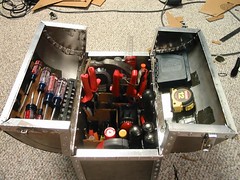
Toolbox FullImage by Austin ampersand Zak via Flickr
The Methodist Church in Britain has a network of District Ecumenical Officers (DEOs).  They work alongside of other denominational ecumenical officers, and the County Ecumenical Officers, to support churches developing ecumenical work.

Their work varies from place to place and person to person but one role they have everywhere is to help with the technical toolbox for ecumenical work, such as constitutions and Sharing Agreements.  Each tradition has its own rules and so it can be helpful to have someone on the ground who knows what they are!  But the DEO role is much wider, they are there to support churches and to encourage new developments.

Most Districts have at least one DEO.  As Districts usually cover more than one county, some of them appoint a DEO for each County. 

It is worth contacting your DEO if you are thinking about:
  • starting a Local Ecumenical Partnership
  • forming a Sharing Agreement, for shared premises
  • starting a Churches Together Group
  • contemplating collaborative work with other traditions, where you want to explore the possibilities.
Today, is the annual meeting for District Ecumenical Officers.  Each year, DEOs have two opportunities to meet.  One in the autumn is usually a joint meeting with Church of England Diocesan Ecumenical officers (and occasionally denominaitonal officers from other traditions) and the other is a Methodist only meeting in the spring.  This latter is an opportunity to catch up on new developments nationally and locally.  Usually, there is a speaker on a topic chosen by the DEOs in the autumn.  This year, they asked for an opportunity to share stories and identify some of the issues they are facing.  About 18 DEOs will be meeting with officers from the Methodist Church and some of our ecumenical partners.
Enhanced by Zemanta

Wednesday, 9 February 2011

21st Century Evangelicals

The Evangelical Alliance and Christian Research have recently published a groundbreaking research report, 21st Century Evangelicals: a snapshot of the beliefs and habits of evangelical Christians in the UK.

Over 17 000 Christians, not all evangelicals, completed the questionnaire to inform this fascinating report.  The report explores the distinctive beliefs of evangelicals compared with other Christians.  The Evangelical Alliance on its website states:

This is the first in a series of groundbreaking reports which will paint a comprehensive and detailed picture of evangelicals in the UK at the beginning of the 21st century. This picture will be an invaluable asset to church leaders and Christian organisations as it provides encouragement, presents challenges, guides reflection and stimulates discussion. And it is critical as we look to the future. By presenting an accurate picture of evangelicals today, we can be much better equipped to make effective plans for tomorrow.

We're doing everything we can to make this report widely available. It can be viewed online, it can be downloaded and it's available as a printed booklet. If you're involved in church leadership, make sure everyone in your church's leadership team takes a look at this report and then spend some time discussing some of the questions this research raises. There are a few discussion questions in the report, and more are available online.

In the months to come we are going to delve deeper in order to understand more fully the beliefs of evangelical Christians and how these beliefs impact their lives. We'd be delighted if you were willing to be part of this exciting research.